Tommy completes his donations
Never Let Me GoTommy completes his donations outside the narrated scene, leaving Kathy to register his loss through what she remembers and the places she revisits. The event’s significance lies as much in its uncertainty as in its finality: even as Tommy and Kathy discuss the fourth donation, they cannot know what follows completion, and Kathy later imagines—but does not allow herself to believe—that he might return.
The Fourth Donation and Its Uncertainties
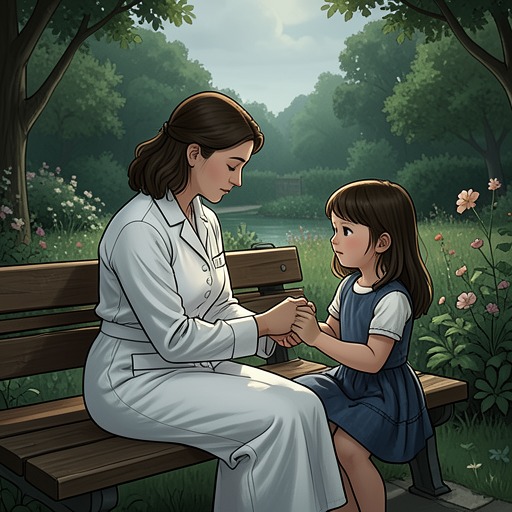
About a week after the notice arrived for Tommy’s fourth donation, he and Kathy discussed what that stage meant. Organ donors could respond to a fourth donation by talking about it endlessly, joking about it, or refusing to discuss it. At the same time, reaching a fourth donation could bring a donor unusual respect: other donors, doctors, and nurses treated it as an occasion worthy of congratulations. That public recognition did not resolve the private uncertainty surrounding what came next.
Tommy told Kathy that people worried so much about the fourth because they could not be certain they would complete; certainty, he thought, would make it easier. Kathy dismissed the speculation as wild talk, but knew she had no evidence for doing so. Their conversation approached a fear neither could settle: that a donor might remain conscious after technically completing, face further donations without a recovery centre, carer, or friends, and be left to wait until being switched off. Kathy describes this possibility as horror-story talk, usually avoided by donors and those around them. She was glad Tommy had confided the fear to her, yet they both drew back from it rather than continuing the conversation.
Completion Outside the Scene
The novel does not narrate Tommy’s completion directly. Instead, Kathy refers to hearing that he had completed, and later recalls that she lost him. The absence of a final scene gives no account of where the completion took place or what Tommy experienced at the end. His fate reaches the reader through Kathy’s retrospective knowledge, not through a description of his last moments.
That gap is sharpened by the fear the couple had already left unexamined. Their conversation had raised the possibility of further donations beyond the point called completion, but Kathy offers no confirmation that this happened to Tommy. The event is final for her, while the procedure’s full boundary remains uncertain in the account she can give.
Kathy’s Return to Norfolk
A couple of weeks after hearing that Tommy had completed, Kathy drove to Norfolk without a particular destination or purpose. She did not go as far as the coast. For about half an hour she followed unfamiliar roads without caring where she was, passing flat fields beneath broad grey skies until she stopped near a small cluster of trees beside a ploughed field.
A fence with two lines of barbed wire kept her from the earth beyond it. Windblown rubbish had caught along the wire, while torn plastic and carrier bags flapped among the branches. Looking at this debris, Kathy imagined that everything she had lost since childhood had washed up there. In her private fantasy, Tommy would appear as a tiny figure on the horizon, grow nearer, and wave or call to her. She did not let the vision develop beyond that possibility. Tears came, but she remained composed, waited briefly, and then returned to her car.
Loss, Memory, and What Remains
Kathy’s imagined return of Tommy is explicitly bounded: she waits, but does not mistake the fantasy for an event. The Norfolk rubbish gathers the image of accumulated losses into a single place, while the absent figure on the far side of the field gives her grief a shape without undoing his completion. Her drive is not a search for a particular object or answer; it is a brief encounter with the possibility of seeing what has been lost gathered before her.
Kathy rejects the idea that her most precious memories will fade quickly. She says she lost Ruth and then Tommy, but does not expect to lose her memories of them. She also carries Hailsham in memory after its closure, without trying to find what has become of the place. As her time as a carer approaches its end, she expects a quieter life at whichever centre she is sent to, with the remembered people and school preserved in her mind. Tommy’s completion thus marks an irreversible loss, but not the disappearance of his place in Kathy’s account of the past.